
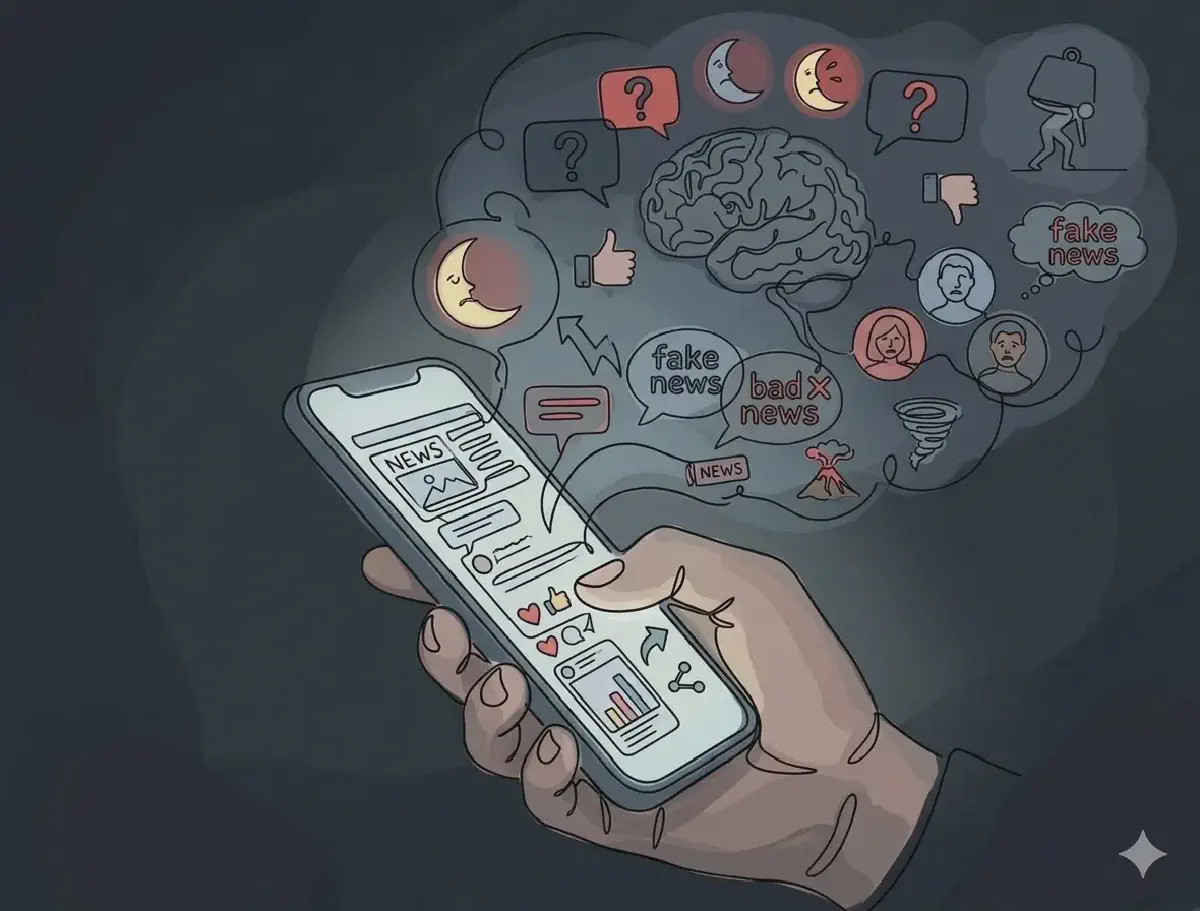
How it actually starts #
After a long day, perhaps a stressful one, you finally sit down or go to bed. You feel tired, either emotionally or physically, but you can’t sleep. You take out your phone and start scrolling randomly on social media like YouTube, Facebook, X (Twitter), Instagram, and TikTok. You just want to find something to cheer you up, some random videos to watch, or to check on content you like. Then, your 15 minutes before sleep turns into an hour, or maybe even more.
So, how does it happen? Why does it feel so natural and comfortable to scroll for hours in bed, even though it eventually makes you feel so bad? It happens because Big Tech companies spend billions of dollars on testing, dopamine triggers, extreme personalization, and emotional logic. They do all of this just to get you hooked in an endless cycle. All that money is spent just to win a few more minutes of your time until you are addicted to the scroll.
Is doomscrolling actually your fault? #
Short answer: Most likely not.
Longer answer: That is it. The rest of this post covers how these platforms keep you scrolling. I will avoid getting into the heavy technical details or processes because that would take hours to read, but I will include links to research so you can dive deeper if you are interested.
Why we get stuck in the loop of doomscrolling #
Slot machine effect: Social media algorithms are like a math problem that updates in real time. They do not just track what you like or share. Instead, they track every single move you make. This includes how you watch a video and the exact second you stop scrolling. By analyzing how much time you spend on specific content, they learn what makes you stay engaged. This allows them to create extremely personalized content just for you.
This is where the slot machine effect comes in. The algorithm does not just feed you everything you like. It intentionally mixes what you like with things that are mediocre or even things you dislike. This is because unpredictability is addictive. That randomness triggers dopamine. It is a psychological loop very similar to a slot machine or gambling.
Negativity bias: this is our brain’s built-in survival instinct that makes we notice, and remember the bad stuff way more than the good. It is a psychological tendency rooted in evolution, back in the day, ignoring a threat meant you didn’t survive, so our brains developed a cognitive bias to react much more strongly to potential “bad” news.
In the modern world, this translates to:
- Focusing on the Negative: We are biologically wired to hunt for threats as a fundamental survival mechanism, which is why a scary headline grabs you faster than a happy one.
- Disproportionate Responses: It causes our brains to give way more “weight” to a single criticism than to a dozen compliments, often root in anxiety or stress.
- Vivid Recall: Because of how our neurons fire, we store negative experiences much more vividly, leading us to dwell on them long after they are over.
Validation seeking: When someone disagrees with you, it creates cognitive dissonance, which is that uncomfortable feeling of having your beliefs challenged. To “fix” that feeling, you might start scrolling to find information or people who agree with you. This is your brain trying to reclaim a sense of certainty and safety.
A bottomless pool of content: In the early days of the web, we had “stopping cues”. You reached the bottom of a page and had to click “Next”. Modern apps have replaced this with the Infinite Scroll.
By removing the “bottom” of the pool, designers have eliminated the natural pause that allows your brain to check back in with reality. Without a stopping cue, you enter a “low control state”. This is a type of digital hypnosis where you continue the action simply because there is no friction to stop you.
The fear of missing out: At its core, FOMO is the modern anxiety that everyone else is having a better time than you are. Social media apps take this very human fear and turn it into a reason to never put your phone down.
- Your brain is a social organ that craves belonging. Today, that means your brain treats a trending topic or a group chat with a high level of importance. It feels like if you do not check your phone right now, you will lose your place in the conversation or miss something vital.
- The speed of the internet also creates a fake sense of urgency. Because everything moves so fast, it feels like information has an expiration date. This keeps you in a state of upward social comparison where you are constantly checking to see how your life measures up to the highlights of everyone else.
- Why it feels like a trap ? You are not just being nosy. You are following a deep drive to stay connected to your community. The “pull to refresh” gesture is a physical sign of this anxiety. You are essentially checking to make sure you have not been left out of what is happening in the world.
- This also create a false sense of connection. We are technically “connected” to hundreds of people, but that connection is frequently an illusion that bypasses our real need for intimacy. Researchers call this the “Social Media Paradox”, it is that social media is designed and advertise to bring us together, yet it often leaves us feeling more isolated than ever.
Sunk cost fallacy: As you scroll for an hour, your brain starts to feel the fatigue. You might feel a bit of guilt or frustration that you have wasted time. Paradoxically, this actually makes you scroll more. Psychologists call this the “Sunk Cost Fallacy”. Your brain feels like it has already invested so much time into the session that it needs to find one “perfect” post or one “worth it” video to justify the hour you just spent. You keep digging deeper into the hole, hoping to find a prize that makes the wasted time feel okay. This is why it is so hard to stop once you have passed the 30 minute mark.
A way to escape reality: Sometimes we do not scroll to find something. We scroll to avoid something. Whether it is a stressful day, a messy room, or an uncomfortable emotion that we don’t want to deal with, the infinite feed offers an immediate “digital exit”, psychologists call this “Experiential Avoidance”. It is a coping mechanism where your brain chooses a low effort distraction to escape a high stress reality.
- The low energy trap: After a long day, your “willpower battery” is drained. Dealing with real life problems takes mental energy that you simply do not have left. Scrolling takes almost zero energy, making it the easiest path to temporary relief.
- Dopamine as a band-aid: Each new video or post provides a tiny hit of dopamine. This does not solve your stress, but it acts like a temporary numbing agent that pushes the “real world” into the background for a few minutes, until you lose track of time and start doomscrolling for hours.
- The dissociative trance: Have you ever noticed that you “zone out” while scrolling? This is a mild form of dissociation.
It is not your fault #
You are not being lazy. You are a human being trying to deal with stress using the only tools you might have available. The real problem is that your way of escaping the present was built by big tech companies. These corporations spend billions of dollars to profit from your emotional state. They have turned your need for a mental break into a product for their bottom line.
Small talk #
Now that you know what you are dealing with, I hope you take care of your mental health. I also had problem with doomscrolling a few years ago. I spent many nights just lying in bed while scrolling my life away. You are not struggling alone in this. Cheers, friends :)
Some links i talked about earlier #
Dopamine-scrolling: a modern public health challenge requiring urgent attention